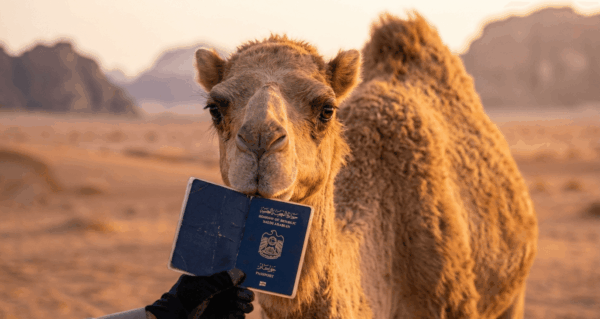
Picture this: You’re scrolling through travel news and see a headline about camels getting passports in Saudi Arabia. Your first thought? “This has to be a joke, right?”
Wrong. It’s completely real—and once you understand why, it actually makes perfect sense.
Saudi Arabia has introduced an official camel passport system, and it’s solving real problems while preserving one of the Kingdom’s most cherished traditions.
Let me walk you through what’s happening, why it matters, and what it means for travelers curious about this fascinating Middle Eastern destination.
Quick Answer: Camel passports are official identification records used to verify ownership, prevent theft, and manage livestock in Saudi Arabia. Each passport links to a microchip embedded in the animal and contains detailed information about the camel’s identity, health history, and ownership.
Think of it like a combination of a vehicle registration and a medical record—but for camels.
Here’s why this matters more than you might think.
Saudi Arabia is home to over 2.2 million camels. That’s not just livestock—that’s a SR 50 billion industry (roughly $13 billion USD) involving 80,000 owners across a vast desert landscape.
Without proper documentation, three major issues plagued the camel sector:
When high-value racing camels can sell for over $3 million, proving who actually owns an animal becomes critical. Traditional methods relied on word-of-mouth and tribal reputation, which worked historically but created legal nightmares in modern courts.
Valuable camels were being stolen and sold across regions with no way to trace them back to their rightful owners. Imagine someone stealing your car and selling it three cities away—but there’s no VIN number or registration to prove it’s yours.
Without standardized documentation, buyers had no reliable way to verify a camel’s lineage, health status, or breeding history. This made international trade nearly impossible and suppressed the market value of Saudi camels globally.
The passport system addresses all three issues by creating an official, tamper-proof record for every animal.

The camel passport initiative officially launched on February 3, 2026, under the National Program for the Development of the Livestock and Fisheries Sector.
But the groundwork was laid earlier:
Saudi Arabia designated as the “Year of the Camel” by the Ministry of Culture, celebrating the deep cultural bond between Saudis and these animals.
The Ministry of Environment, Water and Agriculture (MEWA) released comprehensive census data on the camel population.
The full passport system rolled out, requiring all camels to be microchipped and officially registered.
This initiative is a core component of Saudi Vision 2030, the Kingdom’s ambitious plan to modernize its economy while preserving cultural heritage.

The passport itself is surprisingly sophisticated. It’s a green document featuring the Saudi coat of arms—crossed swords and a palm tree—with a golden camel emblem.
But the real magic happens beneath the surface.
Getting a camel passport involves four main steps:
A MEWA-authorized veterinarian implants a subcutaneous microchip in the animal. This chip contains a unique identification number that can’t be altered or removed without detection.
The owner’s identity is verified and linked to the camel in the government database. This creates a legal chain of ownership that can be referenced in disputes or sales.
All information is entered into the “Naama” digital platform—Saudi Arabia’s centralized portal for agricultural and livestock services. The platform even supports voice commands for owners in remote areas.
Once verified, the owner receives the physical passport document, which they must present when selling, transporting, or entering the camel in competitions.
Each passport is remarkably detailed. Here’s what’s included:
| Passport Field | What It Tracks |
|---|---|
| Microchip Number | Primary digital identity anchor |
| Passport Number | Administrative tracking ID |
| Camel Name | Cultural and commercial identification |
| Date of Birth | Age verification for competitions and breeding |
| Breed | Purebred status and genetic lineage |
| Gender | Breeding program management |
| Color | Visual identification marker |
| Place of Birth | Geographic provenance and disease tracking |
| Bilateral Photos | High-resolution images from both sides |
| Vaccination Log | Complete immunization history with vet certification |
The inclusion of photographs from both sides is clever—it makes swapping documents between similar-looking camels virtually impossible.
The passport system isn’t just bureaucratic paperwork. It’s actively enforced at three critical points:
Sellers must present passports for any transaction. Buyers can verify the information on the spot through the Naama app.
Moving camels across regions requires permits that reference the passport. This prevents stolen animals from being moved quickly to distant markets.
Entry to prestigious events like the King Abdulaziz Camel Festival (with prize pools exceeding $80 million) requires valid passport documentation.

Let’s address the elephant—or rather, camel—in the room.
When news of camel passports first broke, it went viral for all the wrong reasons. Social media exploded with memes. Satirical sites had a field day. People assumed it was either fake news or bureaucratic absurdity run amok.
Here’s the truth: This is a legitimate, practical policy that mirrors systems used worldwide.
The concept sounds absurd at first because we associate passports with human international travel. The word “passport” triggers mental images of camels queuing at airport security or getting their photos taken in passport booths.
But in reality, “passport” in this context simply means “official identification document”—similar to how horses have passports in the European Union or how cattle have health certificates in the United States.
Some satirical headlines claimed camels would be “traveling internationally” or “getting visa stamps.” That’s not what’s happening.
The passport is a domestic identification and health record. While it may eventually facilitate cross-border movement within the Gulf Cooperation Council (GCC) region, its primary purpose is internal management and trade regulation.
Saudi Arabia isn’t inventing something bizarre—it’s catching up to international standards:
Required for all equines, tracking ownership, breeding, and medical history.
Mandatory for interstate movement, preventing disease spread.
Uses ear tags and centralized databases to track sheep and cattle.
The camel passport is Saudi Arabia’s version of these proven livestock management systems, adapted to its unique cultural and economic context.

Let’s talk money. In Saudi Arabia, camels aren’t just heritage—they’re serious business.
The camel racing industry is massive in the Gulf region. Prize purses at major festivals can exceed SR 300 million ($80 million), and individual racing camels have sold for over SR 11 million ($3 million).
These aren’t farm animals—they’re elite athletes and genetic assets.
Before the passport system, proving ownership of a stolen champion racer was nearly impossible if the thief moved quickly. Now, every sale requires passport verification, creating a documented chain of custody.
The passport system allows pricing to be based on “accurate and verifiable data” rather than seller reputation alone. Buyers can confirm:
This transparency increases buyer confidence and drives up market values for well-documented animals.
Property disputes over camels can drag through tribal councils and courts for years. With 80,000 owners managing over 2 million animals across vast desert territories, boundary disputes and ownership claims were common.
The passport provides “officially recognized reference” documentation that courts can use to quickly resolve disputes, saving both time and money.

This isn’t just about livestock management—it’s about national transformation.
Saudi Vision 2030 is the Kingdom’s roadmap for economic diversification beyond oil. A key pillar is modernizing traditional sectors while preserving cultural heritage.
The camel passport integrates with the broader “Naama” platform, which manages all agricultural and livestock services digitally. This includes:
By digitizing the entire agricultural sector, Saudi Arabia is creating data-driven policy tools that can optimize resource use in its challenging desert environment.
With climate change intensifying pressure on water resources and grazing lands, the passport system enables strategic planning. MEWA can now track:
This data allows for sustainable management that balances economic growth with environmental protection.
The genius of the passport system is that it strengthens tradition rather than replacing it.
Camel festivals, racing, and breeding competitions remain central to Saudi culture. But now they operate with modern transparency and fairness. The passport doesn’t diminish the cultural importance of camels—it ensures that cultural practices can thrive in a 21st-century economy.
For travelers familiar with pet passports, here’s how camel passports compare:
| Feature | Camel Passport | Pet Passport |
|---|---|---|
| Primary Purpose | Ownership verification and trade regulation | International travel and health certification |
| Scope | Economic and legal documentation | Personal pet transport |
| Enforcement | National markets, festivals, transport checkpoints | International borders and quarantine |
| Mandatory Vaccinations | Varies by region and use | Rabies (typically required) |
| Microchip Requirement | Yes, subcutaneous | Yes, typically between shoulder blades |
| Photo Requirement | Yes, bilateral (both sides) | Varies by country |
The key difference: Camel passports are economic and regulatory tools, while pet passports are travel documents. One manages a commercial sector; the other enables personal mobility.

For travelers visiting Saudi Arabia, understanding the camel passport gives deeper insight into how the Kingdom balances heritage with progress.
The King Abdulaziz Camel Festival attracts approximately 38,000 camels and visitors from across the Gulf region. It’s not just a competition—it’s a celebration of Bedouin culture, complete with traditional markets, poetry, and crafts.
The passport system ensures that these festivals maintain their integrity and prestige.
Saudis refer to camels as the “VIPs of the desert.” The passport initiative reflects the immense love and respect the Kingdom holds for these animals.
Initial skepticism has given way to broad acceptance among camel owners. Traditional herders appreciate that the system protects their assets, while commercial breeders value the enhanced market credibility.
Stray camels have caused fatal highway accidents. The passport system allows authorities to identify owners quickly and create legal accountability.
Over 40 camels were disqualified after X-ray screenings detected artificial enhancements.
The King Abdulaziz Camel Festival is now more organized and prestigious than ever.
Camel breeding farms now offer tourism experiences thanks to increased professionalization.
The camel passport demonstrates how Saudi Arabia modernizes without erasing tradition.
The passport system may support cross-border livestock movement within the Gulf region.
Saudi Arabia’s model could influence camel management systems in other camel-producing nations.
Yes. As of 2026, all camels in Saudi Arabia must be registered with the Ministry of Environment, Water and Agriculture and issued a passport. Registration includes mandatory microchipping provided free of charge through the Naama platform. Camels without documentation cannot be legally sold, transported, or entered into competitions.
Unregistered camels cannot be legally traded or transported. If found stray or involved in accidents, owners may face fines and difficulty proving ownership.
No. Legal sales require passport verification through the Naama platform to ensure a documented chain of ownership.
Livestock identification systems exist globally, but Saudi Arabia’s system stands out for its scale, cultural integration, and digital infrastructure under Vision 2030.
Currently, the passport is primarily for domestic use. International transport still requires separate export and health permits, though the system supports future cross-border traceability.
What sounds like a punchline—camels with passports—turns out to be a sophisticated solution to real challenges in one of the world’s most valuable livestock sectors.
For the 80,000 camel owners managing 2.2 million animals across Saudi Arabia, the passport system provides security, credibility, and legal protection.
And for travelers? It’s a reminder that Saudi Arabia is a place where ancient traditions and modern innovation coexist.
Planning a trip to Saudi Arabia? Explore camel festivals, heritage sites, and desert culture like never before.
This article is for general informational and educational purposes only. Policies and regulations related to camel registration in Saudi Arabia may evolve over time.
Readers should consult official government sources such as the Ministry of Environment, Water and Agriculture (MEWA) for the most current requirements.
Travelers, camel owners, and businesses should verify information directly with official authorities before taking action.








This is the 2nd time we have used Desmo Travel and they were terrific. They spent a lot of time trying to tweak our itinerary to our needs and requests. The whole trip went like clockwork and we had excellent in-country guides and great hotels.
Best experience and service provided by Bhavesh. He is a true gentleman and extremely thorough with his work. Definitely the most stress-free experience especially due to COVID. He knows all the COVID restrictions and guidelines and will ensure you are in the safest hands! Great work and thank you for all the good work! I will definitely be booking here more in future.
My trip was very smooth without any issues. The price of Desmo Travels are also very competitive and they provide what they commit. Hotel services, staff support, and young instructor are really very supportive.